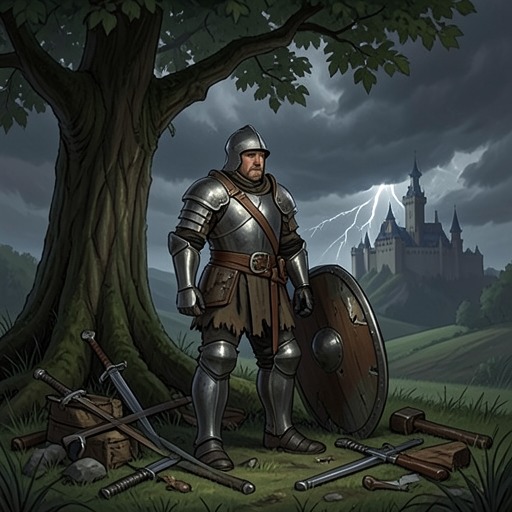
Sir Brandiles
Le Morte d'ArthurSir Brandiles is a knight of Arthur’s fellowship whose scattered appearances show how the Round Table’s reputation is made and tested through encounters on the road, at bridges, and in tournaments. He jousts with Tristram, helps seek the name of a mysterious knight, joins the response to a threatened ambush against Lancelot, and is later among the knights overcome by Lamorak. His episodes give him a place in the fellowship’s collective life rather than a self-contained quest: he recognizes prowess, tests it, and sometimes meets a stronger opponent.
Identity and Place in the Fellowship
Brandiles appears among the knights associated with Arthur’s court and the Round Table. The narrative does not provide a separate account of his family or origins, but repeatedly places him in company with other court knights, including Tor, Kay, Uwaine, and Agravaine. His identity emerges through these group encounters and through the jousts by which knights establish, defend, or revise their reputations.
These appearances present Brandiles as both observer and combatant. He can recognize that an unknown knight’s performance warrants attention, but he also enters the lists himself and is knocked down. The contrast makes his role part of the book’s broader pattern of reputation under pressure: belonging to the fellowship does not guarantee victory, and a knight’s standing must be repeatedly tested in action.
Encounters with Tristram
At a lodging where four knights sat together, Brandiles was among those speaking disparagingly of Cornish knights. Tristram, travelling without disclosing his identity, said little in reply, though he took note of their remarks. The next morning Brandiles offered to joust with him and was struck from his horse. Tor was likewise defeated, while Kay followed after Tristram but did not join his company.
Brandiles then wanted to know who had bested him. He and Kay caught up with the stranger near a well, where Tristram had removed his helmet to drink. When Tristram saw them approach, he put his helmet back on and took to his horse. Brandiles clarified that they had not come to joust again, but wanted him, as a matter of knightly courtesy, to reveal his name. Tristram agreed: he was Sir Tristram de Liones and the nephew of King Mark of Cornwall.
Brandiles welcomed the discovery and explained that he and his companions belonged to a fellowship eager for Tristram’s company. Tristram thanked them but said he did not yet consider his own deeds worthy of the Round Table. The exchange turns Brandiles’s defeat into a moment of recognition: the unknown Cornish knight whom the group had disparaged proves to be the very companion its fellowship most desires.
Responses to Danger and Prowess
Brandiles also appears among the knights drawn into the danger surrounding Lancelot. A damsel reveals that Morgan le Fay has arranged for thirty knights to lie in wait for him, intending to have him killed. She seeks help from Arthur’s court, and Brandiles is named among the knights she encounters with Bors, Bleoberis, and Ector. The four promise to be near the place where Lancelot is expected, ready to come to his aid if the attackers set upon him.
In another episode, Brandiles rides with five other knights of Arthur’s court, including Uwaine, Agravaine, and Mordred. Dinadan sees the party and tries to draw King Mark into jousting them; Mark, seeing that the others outnumber him and Dinadan, rides away. Dinadan then approaches the Round Table company, whose members recognize and welcome him. Brandiles’s presence in this group again locates him within the fellowship’s moving, public world of challenges and recognition, though the episode does not record him personally jousting Dinadan.
Defeat by Lamorak
At a priory tournament, Gawaine and his brothers ride against other knights, while Tristram, Lancelot, and Dinadan hold back, allowing Gawaine’s side the chance to win the prize. Gawaine performs strongly, and Arthur and the assembled knights initially give him the honour. A newcomer then enters with a shield concealed beneath a leather covering. He unseats two knights before the covering comes away, revealing a red shield.
The knight is Lamorak, who defeats three of Gawaine’s brothers and then unhorses Gawaine. Brandiles is among the twenty knights whom Lamorak overthrows in the sight of Arthur. The scale of that performance makes the tournament’s recognition of prowess a public reversal: the honour first given to Gawaine yields to Lamorak’s evident superiority, and the prize is awarded to him as peerless. Lamorak then withdraws toward the forest, while Arthur watches him closely. Brandiles’s defeat is one part of the larger display through which the narrative establishes Lamorak’s exceptional strength.
Narrative Role
Brandiles has no single continuous arc in the recorded episodes; instead, he helps connect the book’s recurring scenes of fellowship, challenge, and assessment. His encounter with Tristram shows a knight willing to joust and then to seek the identity of the man who defeated him. His promise to help protect Lancelot places him among the court’s responders to a treacherous plot, while his defeat by Lamorak marks the limits of collective reputation against an exceptional individual.
Taken together, these appearances make Brandiles a measure of the fellowship’s activity rather than its central hero. He voices or shares the courtly assumptions that encounters can test, participates in efforts to defend a companion, and bears witness through his own defeats to the changing hierarchy of prowess. The episodes’ emphasis falls not on a final resolution for Brandiles but on the continual making and unmaking of knightly standing in the Round Table’s company.